> ## Documentation Index
> Fetch the complete documentation index at: https://docs.near.org/llms.txt
> Use this file to discover all available pages before exploring further.
# NEAR Accounts
> Learn about NEAR Protocol's account model, including named and implicit accounts, access keys, permissions, and how NEAR accounts differ from other blockchain platforms.
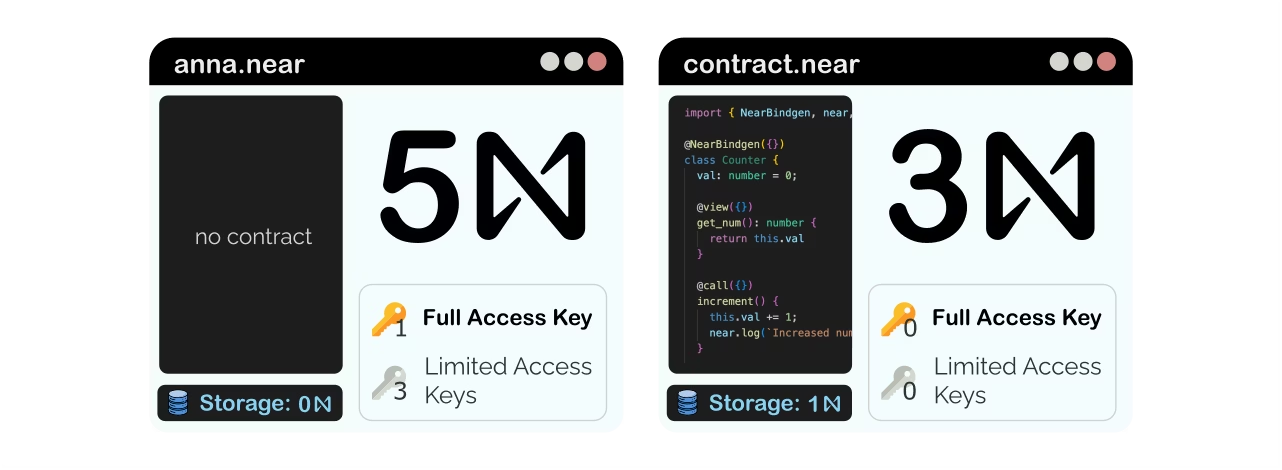
Users participate in the NEAR ecosystem through their NEAR accounts. These accounts are identified by a [unique address](./account-id), can optionally hold a [smart contract](/smart-contracts/what-is), and are controlled through [Access Keys](./access-keys).
By signing [transactions](../transactions) with their account, users can:
1. Send and receive **digital assets** (such as tokens or collectibles)
2. Create and interact with on-chain applications known as **smart contracts**
3. Control accounts in **other chains** (such as Ethereum or Bitcoin) ✨
4. Help onboard new users by **covering the costs** of their transactions (gas fees)
**Want to create an account?**
Check out our tutorial on [Creating a NEAR Account](/getting-started/create-account) to get started!
***
## Account Model Overview
Let's take a closer look at the different elements that compose the NEAR account model.
 ### [Account ID](/protocol/accounts-contracts/account-id)
NEAR **natively** implements multiple types of accounts, including:
1. **Named accounts** such as `alice.near`, which are simple to remember and share
2. **Implicit accounts** such as `fb9243ce...`, which are derived from a private key
3. **Ethereum-like accounts** which are compatible with Ethereum wallets
### [Account ID](/protocol/accounts-contracts/account-id)
NEAR **natively** implements multiple types of accounts, including:
1. **Named accounts** such as `alice.near`, which are simple to remember and share
2. **Implicit accounts** such as `fb9243ce...`, which are derived from a private key
3. **Ethereum-like accounts** which are compatible with Ethereum wallets
### [Multiple Keys](/protocol/accounts-contracts/access-keys)
NEAR accounts can have multiple [keys](/protocol/accounts-contracts/access-keys), each with their own set of permissions:
* You can easily swap keys if one gets compromised
* You can use keys as authorization tokens for third-party applications
### [Smart Contracts](/smart-contracts/what-is)
NEAR accounts can optionally hold an application - known as a [smart contract](/smart-contracts/what-is) - which can be written in Javascript or Rust.
***
## Comparison With Ethereum
If you're familiar with development on Ethereum, it's worth making a quick note about how accounts are different. The table below summarizes some key differences:
| | Ethereum Account | NEAR Account |
| --------------- | ------------------------ | -------------------------------------------------------------------------------------- |
| Account ID | Public Key (`0x123...`) | - Native named accounts (`alice.near`)
- Implicit accounts (`0x123...`) |
| Secret Key | Private Key (`0x456...`) | Multiple key-pairs with permissions:
- `FullAccess` key
- `FunctionCall` key |
| Smart Contracts | Synchronous execution | Asynchronous execution |
| Gas Fees | In the order of dollars | In the order of tenths of a cent |
| Block Time | \~12 seconds | \~600 milliseconds |