

 This innovation leverages Multi-Party Computation (MPC) and a distributed network of node operators to create joint signatures from arbitrary payloads, allowing NEAR accounts to control external blockchain accounts.
Derive addresses on any blockchain, build DeFi on Bitcoin, create multi-chain apps with one contract, or enable account abstraction across all chains - all without the need for traditional bridges or wrapped tokens
This innovation leverages Multi-Party Computation (MPC) and a distributed network of node operators to create joint signatures from arbitrary payloads, allowing NEAR accounts to control external blockchain accounts.
Derive addresses on any blockchain, build DeFi on Bitcoin, create multi-chain apps with one contract, or enable account abstraction across all chains - all without the need for traditional bridges or wrapped tokens
Chain Signatures vs. Traditional Bridges
How does it work?
When a NEAR account - could be a user or a smart contract - wants to interact with a foreign blockchain, it just need to follow four simple steps.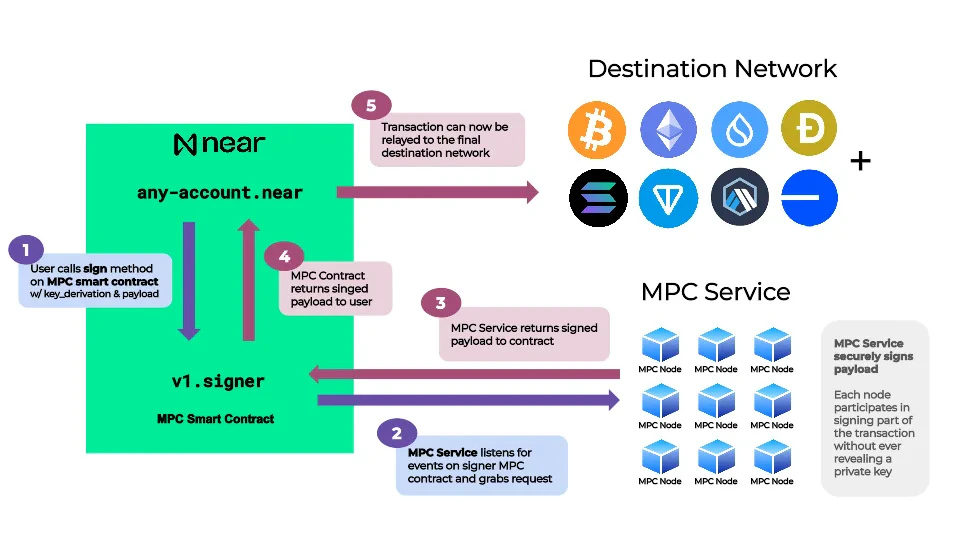
1. Deriving Foreign Addresses
Chain Signatures uses derivation paths to represent accounts on foreign blockchains The NEAR account’s name and the derivation path are used to mathematically derive a unique address for the user on the foreign blockchainDerivation Paths
Derivation Paths
A NEAR account will always derive the same address on the foreign blockchain using the same derivation pathNotice that, since the foreign address is derived from the NEAR account name, it is not possible for another NEAR account to control the same address
2. Creating the Transaction
The client constructs the foreign transaction to be signed, which varies depending on the target blockchain3. Requesting the Signature
A NEAR account or contract calls the sign method of the MPC smart contract (v1.signer) to sign the transaction and waits while our MPC service generates the signature4. Relaying the Signature
Once the signature is ready, the client reconstructs the signed transaction using the signature and broadcasts it to the destination blockchainUse Cases
Chain Signatures can be used to build a wide range of applications that leverage blockchain interoperability. Here are some examples:- DeFi on Bitcoin (and other chain without smart contracts)
- Chain signatures allow NEAR smart contract to program assets on Bitcoin
- Build lending, swaps, runes launchpads, passkey-based Bitcoin wallets, and more
- Chain agnostic applications
- Since chain signatures can sign transactions for all blockchains, developers can support every single chain with just one smart contract
- Multichain DEXs, lending protocols, oracles, derivatives, and more
- Multichain account abstraction
- Users can control assets on all chains with just their NEAR account, and can utilize account abstraction features on any chain including passkeys, key rotation, etc
- Using the multichain gas relayer, users can pay for gas fees on any chain using USDC
- Privacy
- Chain signatures can be used to encrypt and decrypt information in a programmatic way
- This enables privacy applications, and even decrypting information based on ownership of assets/NFTs
How to Get Started?
- Familiarize Yourself with Chain Signatures:
- Understand the basics of Chain Signatures and how they simplify blockchain interactions.
- Review the technical explainer.
- Explore the Use Cases:
- Review examples of use cases for Chain Signatures, such as Multichain DAO, Multichain NFT Minter, and Bitcoin Runes Airdrop.
- Access Resources and Documentation:
- Visit the Chain Signatures documentation for detailed technical information and code snippets.
- Check out the Linktree for Chain Signatures for various resources, including demos and tutorials.
- Try the Demos:
- Use the command-line-based demo to derive accounts and send transactions on Bitcoin, Ethereum, Doge, and Ripple.
- Check out the web app demo.
- Engage with the Community:
- Join the Chain Abstraction developers’ channel on Telegram to connect with other developers and get support.
Common Questions
What blockchains are supported?
Bitcoin, Ethereum, Dogecoin, Ripple, Cosmos chains, and any blockchain that supports ECDSA or EdDSA signatures. More chains are continuously being added.Do I need to lock tokens in a bridge?
No. Chain Signatures directly control native assets on the target blockchain. No wrapped tokens, no bridge risk.Can smart contracts use Chain Signatures?
Yes! NEAR smart contracts can sign transactions for other blockchains, enabling programmable cross-chain applications.How secure is the MPC system?
The MPC network is decentralized across multiple node operators. No single node has access to the full private key. Requires threshold consensus to sign.What’s the difference from account abstraction?
Chain Signatures enables account abstraction across all chains. Your NEAR account (with passkeys, 2FA, etc.) can now control assets on Bitcoin, Ethereum, and more.How much does it cost?
You can sign transactions on NEAR for free, but the external account will still need tokens to pay for gas fees in the target blockchain.Where to Learn More?
To dive deeper into Chain Signatures and its applications, you can explore the following resources:- Technical Blogs and Deep Dives: Read high-level use cases and technical explainer posts on the NEAR blog
- Community and Support: Engage with the NEAR community on social media platforms like Twitter and participate in discussions to stay updated on the latest developments