

Trade Blockchain assets without transactions
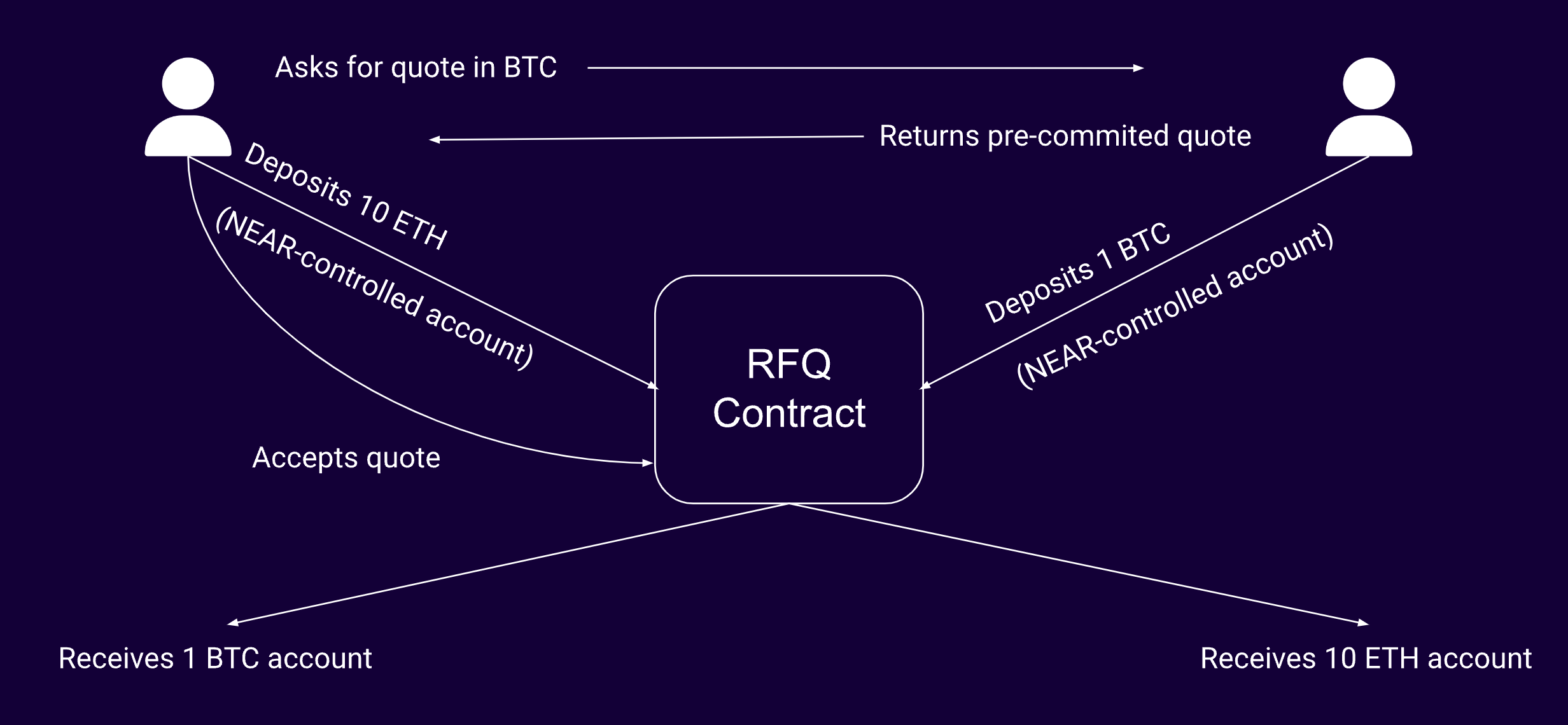
Trading assets across different blockchains usually requires using a bridge that supports them, bringing longer settlement times as the trades are not atomic and require confirmation on both blockchains. Using Chain signatures, you can trade assets across chains simply swapping the ownership of NEAR accounts that control funds on different blockchains. For example, you could trade a NEAR account that controls a Bitcoin account withX BTC for another NEAR account that controls an Ethereum account with Y ETH.
This way, you can keep native tokens on their native blockchain (e.g., BTC on Bitcoin, ETH on Ethereum, ARB on Arbitrum) and trade them without bridges.
As an added bonus, trades are atomic across chains, settlement takes just 2 seconds, and supports any token on any chain.
For example, a basic trade flow could be:
- Users create an account controlled by NEAR chain signatures
- Users funds these accounts on the native blockchains (depositing)
- Place orders by funding a new account for the total amount of the order
- Another user accepts the order
- Users swap control of the keys to fulfill the order
Oauth-controlled Blockchain accounts
On-boarding is a huge problem for decentralized applications. If you want widespread adoption you can’t expect people to keep seed phrases safe in order to use an application. An attractive way of managing Web3 accounts is to use existing Web2 accounts to on-board users. This can be done in the following way:- Deploy a NEAR contract that allows the bearer of a user’s JWT token to sign a blockchain transaction (Ethereum, Polygon, Avalanche, and others)
- The user validates their identity with a third-party receiving a JWT Token
- The user holding that token can interact with blockchain applications on Ethereum/Polygon/+++ via the NEAR contract for the duration of its validity
JSON Web Tokens are a standard RFC 7519 method for representing claims securely between two parties. They are used in this example to represent the claim that someone is the owner of an Oauth account.
Cross-chain Zero-friction onboarding
Using unique features of the NEAR account model, Keypom provides zero-friction onboarding and transactions on NEAR. They are generally used for NFT drops, FT drops, and ticketing. A generic Keypom user-flow could be:- The developer creates a restricted NEAR account
- The account is funded with
NEAR - The user receives a key with limited control of the account
- The user uses the funded account to call controlled endpoints on NEAR
- The user returns the remaining funds to the developer and their account is unlocked
DeFi on Bitcoin (and other non-smart contract chains).
Using chain signatures, smart contracts on NEAR can control externally-owned accounts on non-smart contract chains like Bitcoin, Dogecoin, XRP Ledger, Bittensor, Cosmos Hub, etc. This enables developers to use NEAR as a smart contract “layer” for chains that do not support this functionality natively. For example, a developer can build a decentralized exchange for Bitcoin Ordinals, using a smart contract on NEAR to manage deposits (into Bitcoin addresses controlled by the contract) and to verify and execute swaps when two users agree to trade BTC for an Ordinal or BRC20 token. Example:- Seller generates a deposit address on Bitcoin that is controlled by the marketplace smart contract on NEAR via chain signatures
- Seller deposits a Bitcoin Ordinal to the deposit address
- The Ordinal is listed for sale with a price and a pre-commitment signature from the seller
- Buyer accepts the order, deposits USDC
- The control of the Bitcoin Ordinal address is given to the buyer, USDC on NEAR is transferred to the seller
Using Chain Signatures
With Chain Signatures you can do the same but across many chains, for example Polygon:- The developer creates a restricted NEAR account with a key
- The account is funded with
NEARandMATIC - The user receives a key with limited control of the account
- The user uses the funded account to sign payloads calling controlled endpoints on Polygon
- The user returns the remaining funds to the developer and their account is unlocked